**** Commodore 64 Basic V2 ****
64K RAM system · 38911 basic bytes free
Ready.
VIC-X
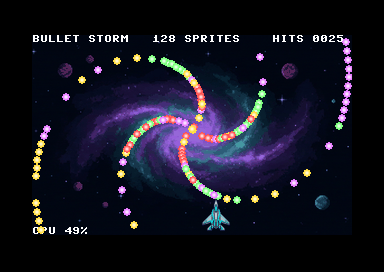
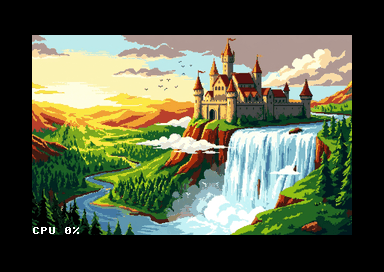
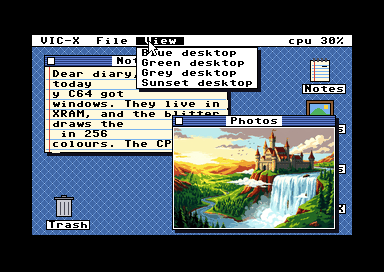
A graphics and memory extension for FPGA Commodore 64s. A stock program sees no difference, until it unlocks VIC-X and the machine gains 256 colours, two scrolling layers and 128 sprites.
The upgrade the
C64 never got.
Everything lives inside the FPGA beside the original video chip. Stock VIC-II behaviour is untouched, so existing software keeps running exactly as it always has.
Two scrolling layers
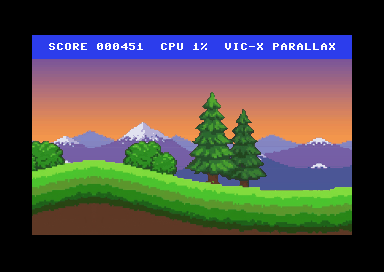
4-bit or 8-bit colour, 8×8 or 16×16 tiles, maps up to 256 tiles each way, with smooth wrapping scroll.
A real sprite engine
128 sprites from 8 to 64 pixels in each direction, 32 on a line, with collision groups.
DMA blitter
Copy, fill, masked and 2D operations, scaled copies, mirroring and colour remapping, chained into lists.
Room to work
128 KB of video memory, plus 16 MB of extended memory shared with the RAM Expansion Unit.
Wide window
Layers and sprites can spill into the border and fill the whole screen.
Easy on the CPU
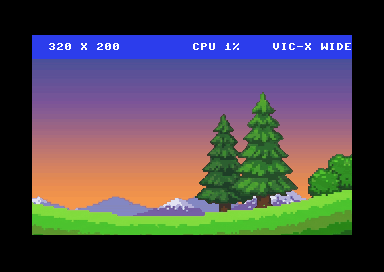
The hardware does the heavy lifting. The parallax demo runs with the 6510 at about 1% load.
Three bytes
to unlock it.
VIC-X stays invisible until a program writes a three-byte key to one register. Until then the machine is a stock Commodore 64, checked against the VICE emulator's own VIC-II test programs.
$56 $58 $21→ written to $D06FIn ASCII, that key spells VX!
Running on a
Commodore 64.
Emulator captures from the demo set. Each one keeps a CPU meter on screen to show how little work the processor is doing.
Emulator first.
Then real gates.
VIC-X is designed for FPGA-based machines: the Ultimate 64 Elite II, the Commodore 64 Ultimate and the 64C Ultimate. It is modelled first in a fork of the VICE emulator, then built in VHDL and run on a MiSTer core.
- 01
Emulator model
A fork of VICE acts as the reference implementation that everything else is checked against.
- 02
Conformance tests
More than 35 test programs confirm the hardware and the emulator agree.
- 03
FPGA hardware
The VHDL block already runs on MiSTer. Testing existing games to prove nothing breaks is next.